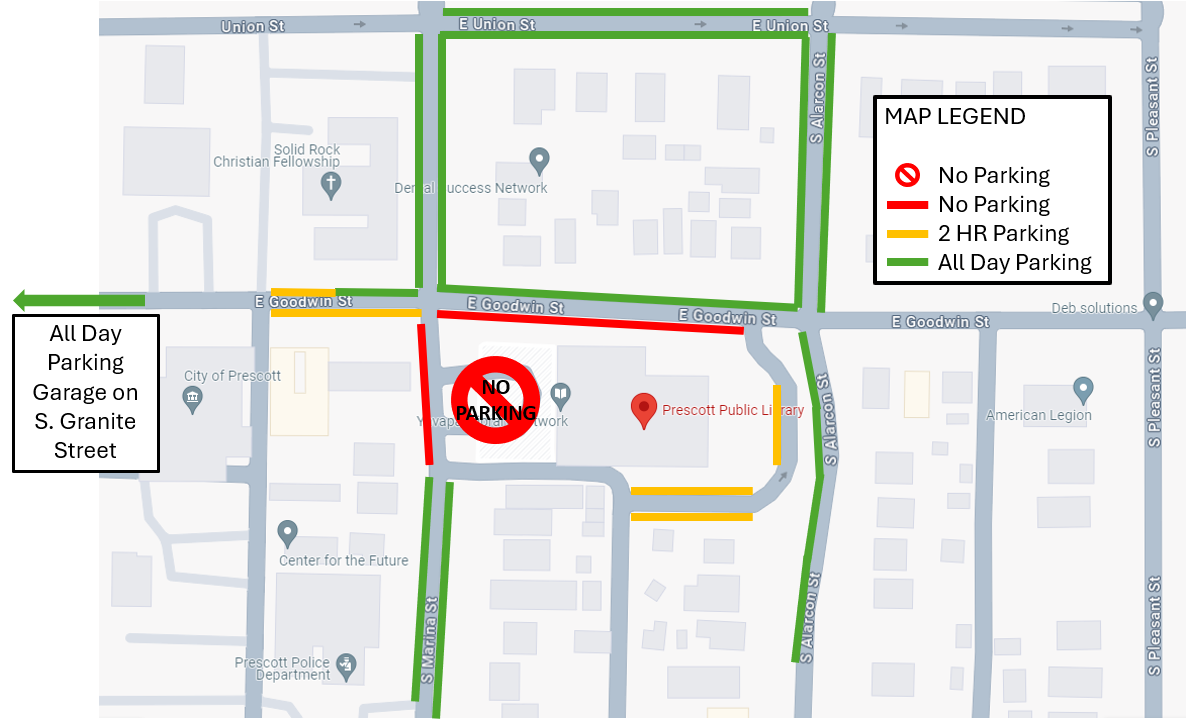
Parking will be limited on Friday, May 30 for Fest in the West.  Please check the map for availability.

Prescott Public Library

Local History

Prescott Public Library History

While Prescott’s first library was a wagon of 300 books brought by Richard McCormick, the Prescott Library Association was a group formed about 1875. John Marion, editor of the Arizona Miner, said in 1870, “Prescott is a young town, and a small one, yet we think it is high time our people were taking some steps towards funding a public library here. A public library is a big card for any town, and the establishment of one here could not fail to benefit residents and strangers.” The town was in agreement, and over the next twenty or so years, the library was hosted in several places, including the homes of Prescott citizens. Things changed in 1895 when Julia Goldwater, on behalf of The Monday Club, wrote to Andrew Carnegie, asking him to grant the Prescott Library Association with $8,000 so that a library could be built. He granted “the last half of $4,000,” which was to say if the Prescott Library Association raised $4,000, he would match their funds. Funds were raised in large part to donations from Prescott citizens, Montana Senator William Clark (after whom Clarkdale is named), railroad entrepreneur Frank Murphy, and his business partner E. B. Gage. The Carnegie Library opened its doors November 24, 1903. One paid librarian was on staff, managing a closed (not browsable) collection of 1,300 books.

The next fifty years of the Prescott Public Library at the Carnegie Library were years which saw an explosion of the population of the City of Prescott as well as interest at the library. By the fiftieth anniversary of the Carnegie Library, librarian Alice Metzger predicted that at this rate, the library’s collections and programs would be outgrowing its current building. She was correct, and much of the 1960’s and 1970’s were spent searching for a new space and asking the public what they were looking for. By the time the library at Goodwin Street and Marina street was being built, the Prescott Public Library had to use the basement of City Hall for technical services, mending, and periodical storage. When the Prescott Public Library opened its doors at the new location on May 17, 1975, it boasted a collection of 70,000 books, newspapers, periodicals, and phonograph records, and moved into a space that was 15,000 square feet. As the population of Prescott continued to expand alongside library interest, that square footage of the library doubled in 2006. In 2025, Prescott Public Library celebrated 50 years of service at the Goodwin Street location.

In 1963, Library Director Allen Rothlisberg said, “The average library lasts 45 years. We’ve been around 60.” Due to the generous support of the Friends of the Library and the patrons of the Prescott Public Library, this library has exceeded all expectations.

Elisabeth Ruffner Timeline

Working in collaboration with the Ruffner family, Prescott Public Library staff created an interactive timeline of Elisabeth Ruffner’s life and accomplishments. Ruffner had a long and impactful relationship with Prescott Public Library and we are honored to host this history. From open space advocacy to fierce protection of historic buildings, Elisabeth helped shape the Prescott we know and love today. We invite you to learn more about her life – and to follow her example!

Granite Mountain Hotshots Tribute Fence
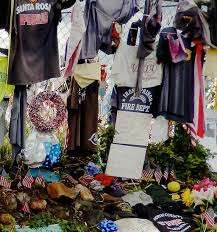
Flags, T-shirts, artwork, toys and thousands of letters. Tributes of every kind were left to honor the memory of the Granite Mountain Hotshots between June 30 and September 10, 2013.

The Tribute Fence Preservation Project (TFPP) and Prescott Public Library partnered with the Arizona State Library, Archives and Public Records to create an online digital collection of materials left in tribute for the Prescott Granite Mountain Hotshots.  This digital collection is available to the public as part of the Arizona Memory Project.

Beginning June 30, 2013, the day that nineteen Granite Mountain Hotshots died fighting the Yarnell Hill Fire, the fence outside Fire Station 7 became a place of tribute and mourning. In September, an amazing group of volunteers recognized the need to preserve the tangible outpouring of community grief and respect along the fence at Prescott Fire Station 7.  Led by Jan Monroe and Dottie Morris, the volunteers began to carefully remove t-shirts, flags, toys and artwork from the fence, photographing them and documenting details. Six months and 10,000 photographs later, Jan and Dottie identified the Arizona Memory Project as the perfect place to make these digital records available to the public, creating a kind of online museum about the Tribute Fence.

Prescott Public Library provided the assistance the TFPP volunteers needed to make this poignant part of our city’s history available worldwide. For more information about the project, contact 928.777.1526.